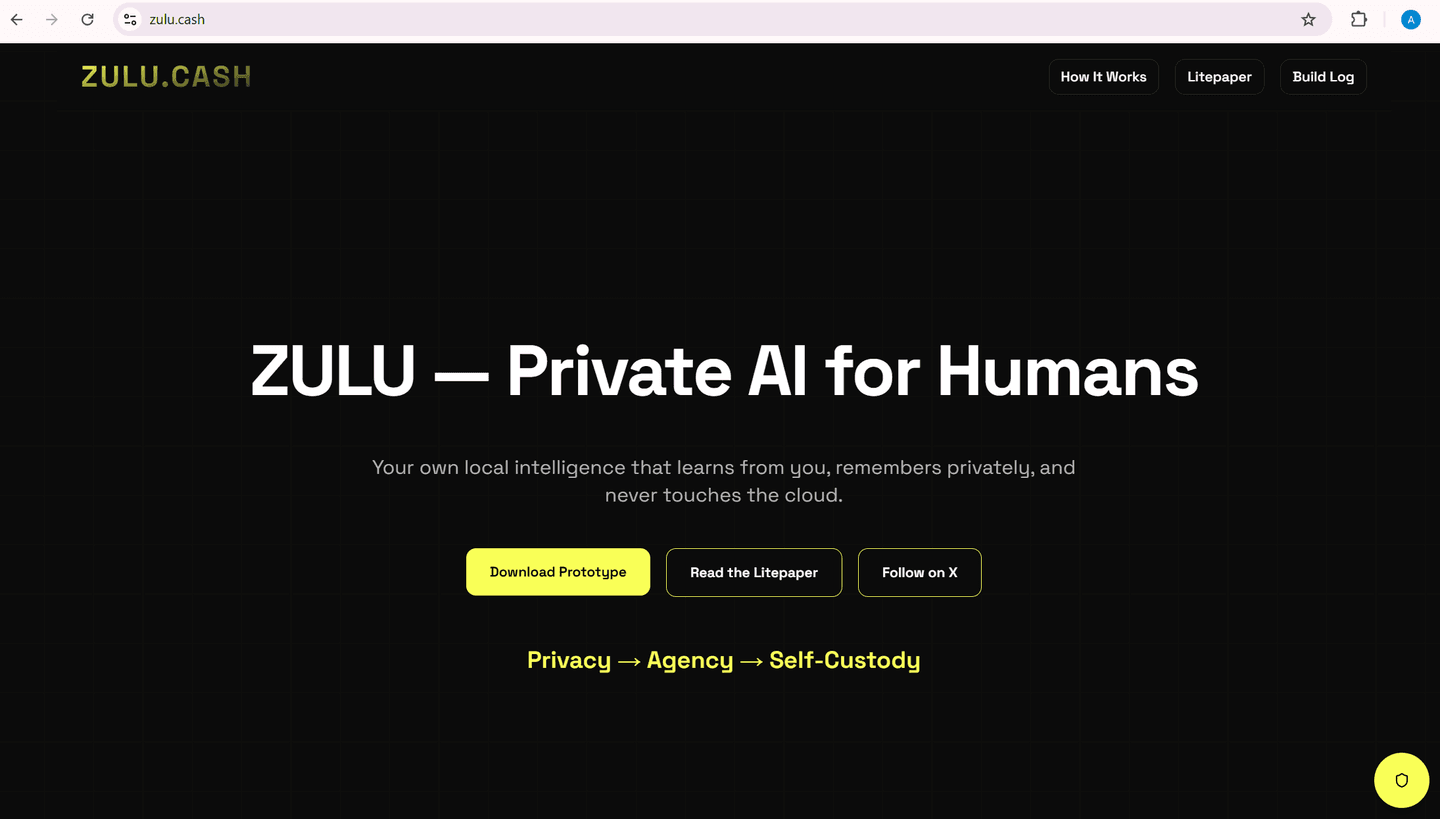
ZULU.CASH
Your intelligence. Your memory. Your machine.
Created on 4th December 2025
•
ZULU.CASH
Your intelligence. Your memory. Your machine.


The problem ZULU.CASH solves
Modern AI is built on surveillance. Every conversation, meeting, thought, and decision you feed into today’s cloud models is logged, profiled, and used to train systems you don’t control. Users don’t own their data, their memory, or their identity. They’re renting intelligence from companies whose business model is extracting and monetizing their behavior.
Zulu.cash solves this by flipping the architecture.
Zulu is a local-first AI agent that runs entirely on your device. It listens, reasons, and stores memory without ever sending data to a cloud or third party. Transcription, understanding, and long-term memory all stay encrypted and local. There is no telemetry, no account, no centralized database, no behavioral analytics.
People use Zulu to capture meetings, organize knowledge, track tasks, and run real automations — but in a way that’s private by design. Instead of giving your life to a remote model provider, you own the agent and the memory it builds.
Zulu makes everyday tasks easier and safer by removing the surveillance layer entirely. It gives you the power of an AI assistant with the guarantees of a personal computer: your data, your keys, your node.
It’s a simple idea:
AI should be your ally, not your spy.
Challenges I ran into
Building a fully local AI agent exposed every part of the modern AI stack that quietly assumes “the cloud will handle it.” Removing the cloud meant rebuilding everything from scratch and solving problems that most developers never have to think about.
The first major challenge was WhisperX itself. The diarization models were trained on older versions of PyTorch and pyannote, which completely broke on modern environments. I encountered repeated runtime errors, mismatched dependencies, and diarization models refusing to load. I had to isolate versions, rebuild environments, and patch WhisperX so the alignment and transcription pipeline could run cleanly on-device.
The second challenge was performance. Running transcription + speaker segmentation + LLM reasoning locally is heavy. I had to tune model sizes, memory usage, and CPU constraints to make the agent responsive enough for real-time use while keeping everything offline.
A third challenge was building encrypted memory correctly. SQLCipher doesn’t behave like a normal SQLite database. Every interaction needed explicit handling of encryption keys, migrations, and secure writes. Getting memory persistence reliable while keeping it fully encrypted required several redesigns.
Another challenge was designing the agent workflow without relying on remote APIs. Most agent frameworks assume you can just “call a cloud model” or “use a hosted vector DB.” Zulu had to do all reasoning, embedding, storage, and retrieval locally. That forced a more thoughtful architecture and a better separation between inference, memory, and actions.
The last challenge was preparing for MPC and privacy primitives. Even though the full MPC layer isn’t deployed yet, designing the system so that encrypted memory and local computation could later bridge into confidential MPC workflows required careful planning.
Each challenge reinforced the core idea of Zulu: if you want true privacy, you can’t rely on the convenience layer. You have to build the infrastructure yourself.
Cheer Project
Cheering for a project means supporting a project you like with as little as 0.0025 ETH. Right now, you can Cheer using ETH on Arbitrum, Optimism and Base.