Secure-Sight
AI-Powered OSINT for Safer Digital Investigations
Created on 27th October 2025
•
Secure-Sight
AI-Powered OSINT for Safer Digital Investigations


The problem Secure-Sight solves
In today's world, a massive amount of personal and behavioral data is openly shared across digital platforms — social media, blogs, forums, and more. However, there is no unified, AI-driven platform in India that can ethically analyze this open data to detect suspicious behavior, identify online risks, and visualize human digital connections.
Secure Sight bridges this critical gap by offering an AI-powered OSINT (Open-Source Intelligence) platform that:
Automatically collects and analyzes public digital data (social posts, blogs, activities).
Generates structured human profiles with risk scores and connection graphs.
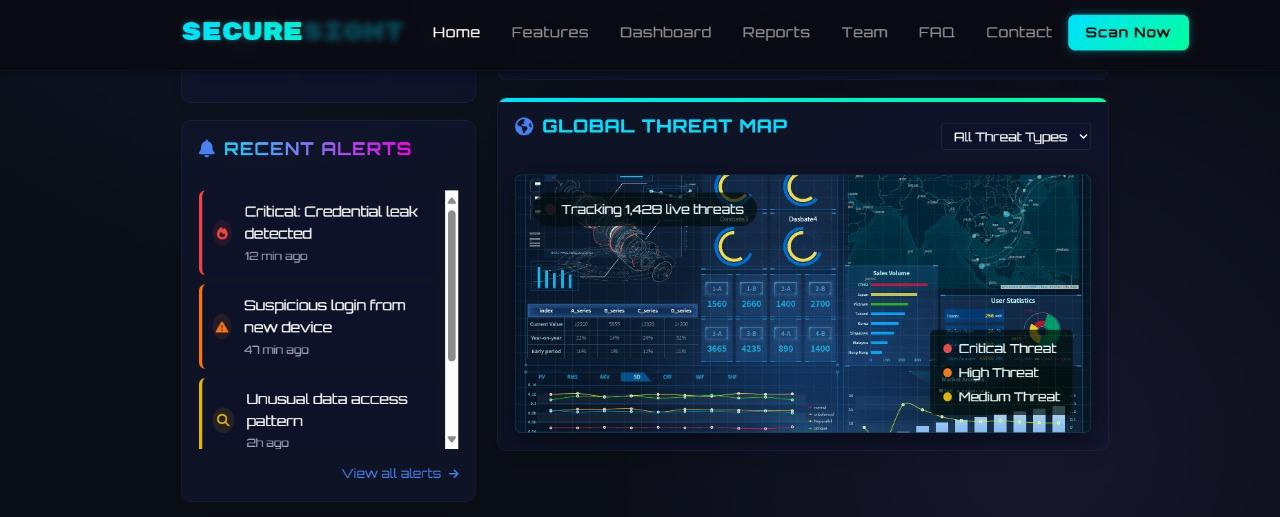
Provides real-time visual dashboards to monitor activity trends and detect anomalies.
Sends automated alerts to authorities or parents for early intervention.
Through this, Secure Sight makes digital monitoring and investigation:
🕵️ Smarter – AI and NLP detect hidden patterns and risks.
⚡ Faster – Automated data collection and profiling reduce manual effort.
🔒 Safer – Ensures responsible and legally compliant intelligence gathering.
It empowers law enforcement, cybersecurity teams, parents, and organizations to act proactively and ensure a secure digital ecosystem for all.
Challenges we ran into
Building an AI-based OSINT platform wasn’t without hurdles — we faced several technical and integration challenges during development:
🔍 Data Structuring Issues:
Problem: Public data from different platforms (like JSON files, social feeds) came in inconsistent formats.
Solution: We implemented data cleaning and normalization scripts using Python and custom parsers before feeding it into our NLP models.
🤖 NLP Accuracy and Risk Scoring:
Problem: Early models failed to correctly classify or assign risk levels due to contextual ambiguity in posts.
Solution: We retrained our model with a context-aware sentiment analysis approach and fine-tuned it using labeled datasets for better accuracy.
⚙️ Backend Integration Conflicts:
Problem: Integrating Flask/Django APIs with the Next.js frontend caused CORS and routing errors.
Solution: We configured proper CORS headers, used a reverse proxy, and adopted consistent RESTful conventions for smooth communication.
📧 Automated Email Alerts:
Problem: EmailJS integration initially failed to send real-time alerts during testing.
Solution: We debugged the API keys, added secure environment variables, and tested on sandbox accounts before deployment.
📊 3D Visualization Lag:
Problem: Implementing 3D connection graphs with Three.js caused performance drops on lower-end devices.
Solution: We optimized rendering by reducing mesh complexity and used lazy loading for visualization components.
Despite these challenges, we successfully built a fully functional prototype that automates open-source intelligence gathering while maintaining speed, accuracy, and ethical compliance.
Tracks Applied (3)