Sampark-OS
Agentic AI:Empowering India’s ₹2761Cr Blue Economy
Created on 15th February 2026
•
Sampark-OS
Agentic AI:Empowering India’s ₹2761Cr Blue Economy


The problem Sampark-OS solves
Information asymmetry is the single largest wealth destroyer for India's 150 million+ unorganized producers — fishermen, farmers, weavers, gig workers. They produce value but capture a fraction of it because they cannot see the market, compare buyers, or negotiate effectively.
We're starting with fisheries to prove the model.
A Kerala fisherman catches 40kg of Karimeen (Pearl Spot) and sells at the harbor for ₹220/kg. The same fish retails at ₹600/kg. The middleman captures ₹380/kg — a 58% gap — not because he adds value, but because the fisherman has no visibility into who's buying, at what price, or which harbor pays premium.
This is not a Kerala problem. This is an India problem:
- 30 million Indians depend on fisheries for their livelihood
- India is the world's 2nd largest fish producer (8% of global production)
- Seafood exports doubled to ₹62,408 crore in 2024-25, yet fishermen get 36% of retail price
- The same pattern exists in agriculture (₹44 lakh crore sector), handloom, dairy, and gig labor
What Sampark-OS does:
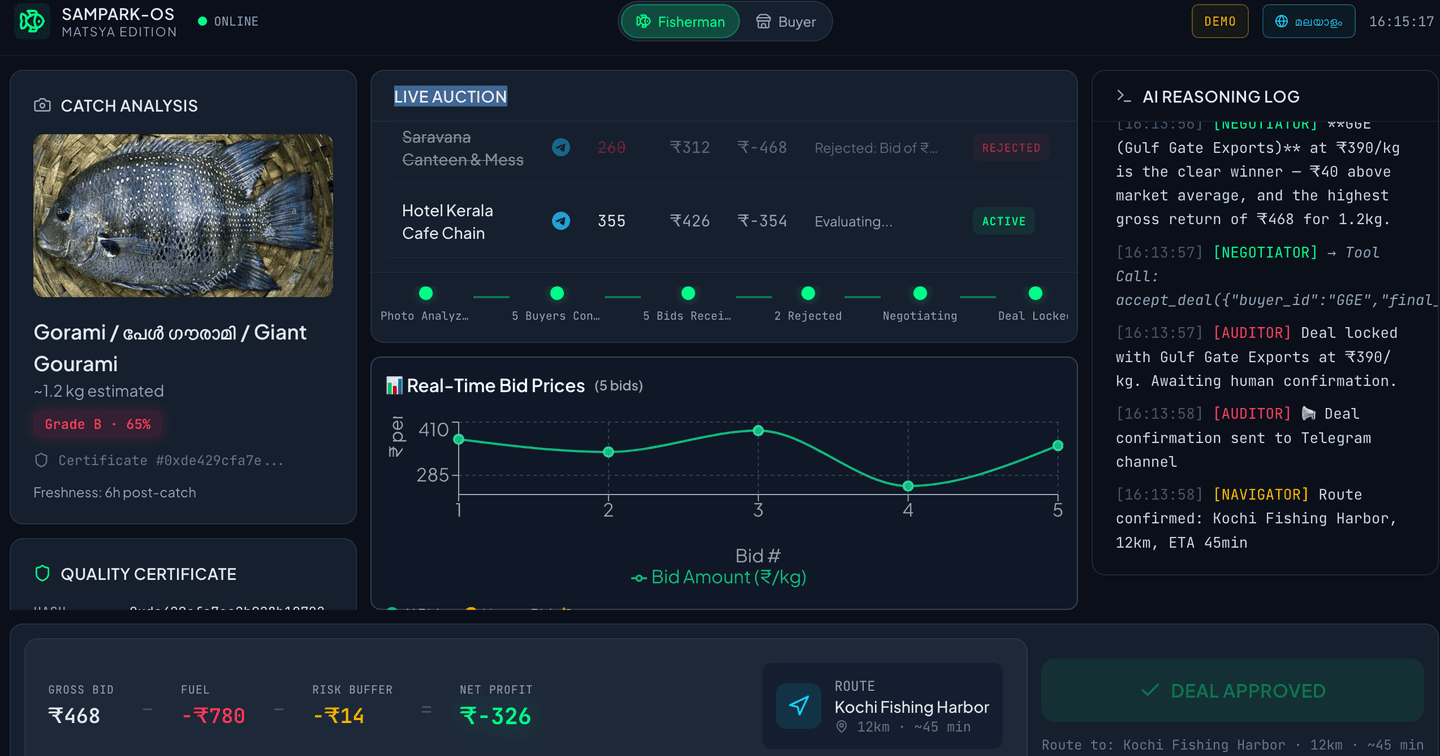
It deploys 4 autonomous AI agents that act as a fisherman's digital CFO. Upload a photo of your catch → Claude Vision grades species, weight, quality, freshness → the NAVIGATOR calculates fuel cost to 5 harbors → the NEGOTIATOR broadcasts to 7+ buyers across WhatsApp (not integrated) and Telegram simultaneously → bids stream in, low offers get REJECTED with reasoning, the best deal gets locked → real Telegram confirmation arrives on your phone.
All in under 7 minutes. The fisherman doesn't need to speak English, download an app, or understand market dynamics. Voice commands work in Malayalam. Buyers bid through WhatsApp /Telegram (future use case) they already use. Result: +88% net income (₹8,800 farmgate → ₹16,520 via Sampark).
In 2007, economist Robert Jensen's landmark study (Quarterly Journal of Economics) proved that mobile phones reduced Kerala fish price dispersion by 8% and eliminated waste entirely. But that was the INFORMATION revolution — phones told fishermen what prices existed. 18 years later, they still can't negotiate with Gulf exporters, compare 7 bids simultaneously, or escape the ₹500/day cold storage trap. Information is now a commodity. What's missing is AGENCY — the ability to act on information autonomously. Sampark-OS closes that gap.
India's Union Budget 2026-27 recognized this. It allocated ₹2,761.80 crore (highest ever) for fisheries, explicitly calling for "market linkages involving startups" and "reducing post-harvest losses to improve price realisation for fishers." 200 fisheries startups are being supported under PMMSY. Fish catch in EEZ/high seas is now duty-free for export. The government is building the infrastructure. Sampark-OS is the intelligence layer on top.
Kerala fisheries is where we prove it works. Agriculture, dairy, handloom, and gig labor are where we scale it across India.
These aren't assumptions — they're validated through field conversations with fishermen and traders at Kochi's harbors:
- Middlemen dominate pricing: Both fish and vegetable markets operate through intermediaries who control access to buyers. Fishermen rarely interact with end-buyers directly.
- First-boat advantage: Boats arriving earliest get the best prices — penalizing fishermen who fish further offshore or face weather delays.
- No standardized pricing: Prices swing based on species, size, quality, and freshness — but fishermen lack tools to grade or benchmark their own catch.
- Location arbitrage: Prices differ across harbors and markets, but fishermen commit to one harbor before knowing which pays more (fuel + time make switching impossible).
- Manual bidding by middlemen: The auction process is entirely manual, run by middlemen or large fishing companies — fishermen have no seat at the negotiation table.
- End-of-day fire sales: As evening approaches, fishermen slash prices to avoid cold storage fees (₹350-500/day) and additional labor costs — middlemen exploit this desperation window.
Every core feature in Sampark-OS maps directly to these real-world pain points:
- End-of-day fire sales → AUDITOR agent's Liquidation Mode (auto-triggers flash sale before cold storage trap kicks in)
- No standardized pricing → SCOUT agent's Claude Vision grading (species, weight, quality grade, freshness — all automated from a photo)
- Manual bidding by middlemen → NEGOTIATOR agent's WhatsApp/Telegram swarm (7 buyers bid simultaneously, AI rejects low offers)
- Location arbitrage → NAVIGATOR agent's fuel ROI calculator (compares 5 harbors with real GPS distances and diesel costs)
- First-boat advantage → Time-based auction with deadline protection (the AI optimizes for the fisherman's schedule, not the middleman's)
Challenges I ran into
-
Building a multi-agent AI system, not a chatbot: The core challenge was orchestrating 4 specialized AI agents (Scout, Negotiator, Auditor, Navigator) within Claude's tool-calling framework. Each agent needs different tools — check_mandi_price, place_bid, reject_and_counter, accept_deal, calculate_fuel_cost, trigger_liquidation — and they must execute in logical sequence. The breakthrough was designing the system prompt so Claude itself decides which agent acts next based on live auction state, rather than hardcoding the flow.
-
Making AI work for non-English, non-tech users: Our target user is a Class 8-pass fisherman in Kadamakudy who speaks Malayalam and can't type while steering a boat. Every design decision had to pass the test: "Can Rajan, 45, use this at sea?" This led to voice-first design with Sarvam AI (Malayalam STT/TTS), WhatsApp/Telegram instead of app downloads, and real-time economics shown visually instead of as text.
-
Real-world economics breaking demo assumptions: Claude Vision estimates fish weight from photos realistically — 1.2kg for a single fish photo. But fuel to Kochi Harbor is ₹780. A 1.2kg catch doesn't justify the trip. The AI was smart enough to recognize this: the AUDITOR agent noted "net is negative due to small catch vs. high fuel cost, but GGE's bid at mandi ceiling is the best possible outcome." This proved the AI reasons about trade-offs, not just maximizes price.
-
Sarvam AI integration quirks: The voice API uses a non-standard header (api-subscription-key instead of Authorization: Bearer), causing silent authentication failures. Also built a translation pipeline (Malayalam → English via Mayura v1) so voice commands could feed into the English-language auction engine.
-
Proving it's a platform, not a tool: Added a Buyer View (Gulf Gate Exports dashboard) alongside the Fisherman View — same auction, two perspectives, one-click toggle. This demonstrates Sampark-OS is a two-sided marketplace. Both views consume the same real-time SSE stream, synchronized via a custom pub-sub store.
Tracks Applied (1)
Hackathon Prizes
Technologies used