NeighbourNet
Your crowd is your network.
Created on 4th April 2026
•
NeighbourNet
Your crowd is your network.

The problem NeighbourNet solves
Every communication tool we rely on — WhatsApp, phone calls, SMS, Google Maps — shares one fatal assumption: there is a tower nearby.
Remove the tower, and billions of smartphones become useless bricks.
This happens constantly, everywhere:
| Situation | What breaks |
|---|---|
| Concert with 50,000 people | Towers saturate, calls drop, location sharing dies |
| Exam hall with a jammer | Cellular blocked, families waiting outside have no update |
| Trek above 3,000m | No coverage, group splits with no way to coordinate |
| Flood, earthquake, cyclone | Towers are the first thing that goes down |
| Dense building, basement, mine | Signal simply doesn't reach |
This is not a rare edge case. This is every crowded place, every jammer zone, every remote area — affecting hundreds of millions of people every single day.
What NeighbourNet Does
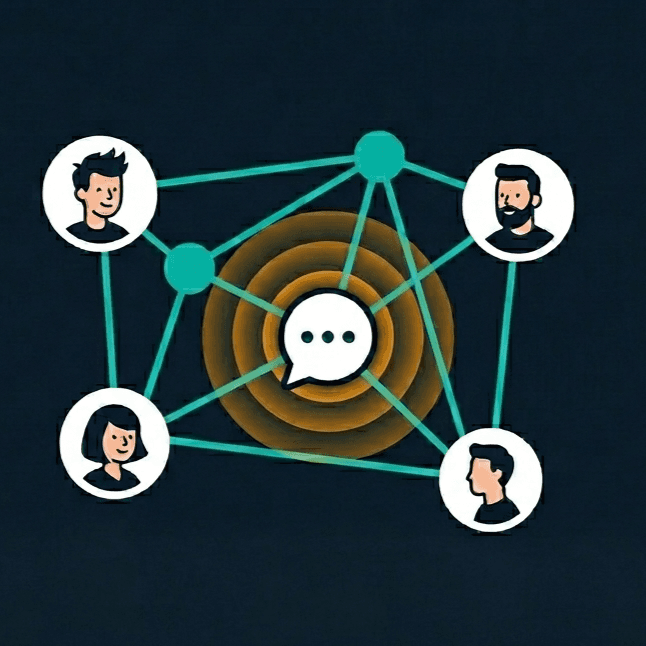
NeighbourNet turns every smartphone into a node in a self-healing peer-to-peer mesh network using only the Bluetooth and Wi-Fi radios already built into every phone on the planet.
No towers. No internet. No new hardware. No infrastructure of any kind.
When you send a message, it doesn't go up to a server and back down. It hops directly from phone to phone — device to device — until it reaches the person you're trying to reach. Every phone in between acts as a silent relay, passing the message forward without the user even knowing.
What You Can Actually Do With It
💬 Chat without any signal
Works exactly like a familiar messaging app — private one-to-one messages, group chats — but the entire conversation travels over the mesh with end-to-end encryption. No server stores it. No tower carries it.
📍 Find your squad in a crowd
Form a group before a concert or event. Each member gets a unique animal mascot on a live map. When signal dies and the crowd swallows your group, you can still see where everyone is and reach them instantly.
🚨 Send an SOS to everyone nearby
One tap fires a broadcast alert that ripples outward across every NeighbourNet phone in range — covering hundreds of metres in seconds. A lost child at a festival. A trekker who has fallen. Anyone nearby who can help will see it.
🔇 Coordinate silently in jammer zones
Jammers block cellular. They don't block Bluetooth. NeighbourNet runs on a completely separate frequency. Students, exam staff, and waiting families can still communicate in silent text-only mode with no sounds or visible alerts.
🏔️ Stay connected in remote areas
Hikers and travellers can form a mesh group before heading into no-signal zones. As long as any two members are within Bluetooth range — directly or through intermediate phones — the network stays alive.
Why This Is a Generic Solution, Not a Niche One
Most offline tools are built for one specific scenario — disaster radios, military comms, event wristbands. They need special hardware, training, or setup.
NeighbourNet needs nothing except the phone already in your pocket.
The mesh doesn't care whether you're at a concert, an exam hall, a disaster zone, or a mountain. The network forms wherever people are. The denser the crowd, the stronger and more resilient the mesh becomes — which means it is most powerful exactly when and where it is needed most.
Where This Goes Next
NeighbourNet is early, but the foundation is built to grow:
- Room-based group channels — persistent offline spaces for neighbourhoods, communities, and organisations
- Government pre-installation — pre-installing on citizen devices creates an instant national mesh that activates automatically in any crisis, with zero user action required
- Organiser dashboard — event venues and safety authorities get live crowd density maps, verified broadcast control, and staff coordination — replacing walkie-talkie rentals at a fraction of the cost
- Emergency system integration — when any mesh message reaches a device with internet, it forwards automatically to emergency services
The long-term vision: every phone on earth is a node in a communication network that no disaster, no government shutdown, and no infrastructure failure can silence. NeighbourNet is the software layer that makes that real.
Challenges we ran into
Building NeighbourNet forced us to solve problems that had no Stack Overflow
answer — because nobody has tried to build a consumer mesh layer on top of
APIs never designed for it.
1. Peers Dropping Silently
Nearby Connections devices would connect successfully then vanish after
60–90 seconds with no error or callback — messages disappearing into nothing.
Fix: Heartbeat ping every 15 seconds. Miss two pings → mark lost →
trigger re-discovery automatically.
2. Messages Looping Infinitely
One message generated 200+ duplicates in 10 seconds across 4 devices and
crashed two phones.
Fix: seen_ids deduplication in SQLite. Every packet carries a UUID —
if already processed, silently drop. TTL expiry auto-purges old IDs.
3. Android Killing Background Relay
Battery optimisation killed relay within 90 seconds of the screen turning
off — creating silent dead nodes the mesh still believed were active.
Fix: Persistent foreground service with wake lock during active mesh
sessions. Trade-off is slightly higher battery, surfaced honestly to users.
4. Broadcast Flooding the Network
6 devices in a room caused a single broadcast to relay 40+ times, queuing
hundreds of duplicate packets and lagging every phone simultaneously.
Fix: Hard hop_limit in every packet header. Broadcast capped at 5
hops, private/group at 12. Relay increments counter — hits limit, packet
dropped. Exponential explosion became a controlled ripple.
5. Audio Packets Too Large to Hop
Raw PCM audio was 1.6MB per 10-second clip. Delivery rate over multi-hop
mesh was under 20%. Gzip brought it to 900KB — still too large. Reducing
sample rate made audio incomprehensible.
Fix: Switched to Opus codec at 8kbps — 10 seconds of voice becomes
~10KB, a 160x reduction. Opus models human speech patterns rather than
encoding raw waveforms, so voice stays clear. Delivery rate jumped to 95%,
matching our text message benchmarks.
6. The Pivot Mid-Build
We built for disaster response — NDRF triage, SOS centrepiece, city-scale
maps. Mentors stopped us cold: "Say disaster and every judge becomes a
skeptic. Have you tested in a real flood? What about Starlink?"
Piyush then shared what actually happened to him — Anupam Roy concert,
50,000 people, separated from his friend for one hour with zero signal.
Mentors leaned forward. That was the pitch.
The core technology didn't change at all. What changed: the opening story,
map zoom from z13 to z17, SOS moved out of main flow, dashboard reframed
from government ops room to venue staff tool, business model shifted from
civic good to "replace ₹15,000 walkie-talkie rentals with ₹999."
The hardest part wasn't technical — it was separating "is this worth
solving?" (yes) from "is this the right way to pitch it?" (no) and
executing a full pivot fast enough to still have something to demo.
Lesson: the best technology doesn't win. The best-told story about the
right technology wins.
Tracks Applied (1)
Best Use of Gemini API

Gemini