HAEMO CORE
Right Blood. Right Place. Right Time.
Created on 20th August 2026
•
HAEMO CORE
Right Blood. Right Place. Right Time.


The problem HAEMO CORE solves
The problem it solves
Blood management across hospitals can be slow and fragmented, especially during emergencies. Hospitals may have limited visibility into the availability of compatible blood at nearby facilities, while manual coordination, delayed inventory updates, and inefficient tracking can increase response time and contribute to blood wastage.
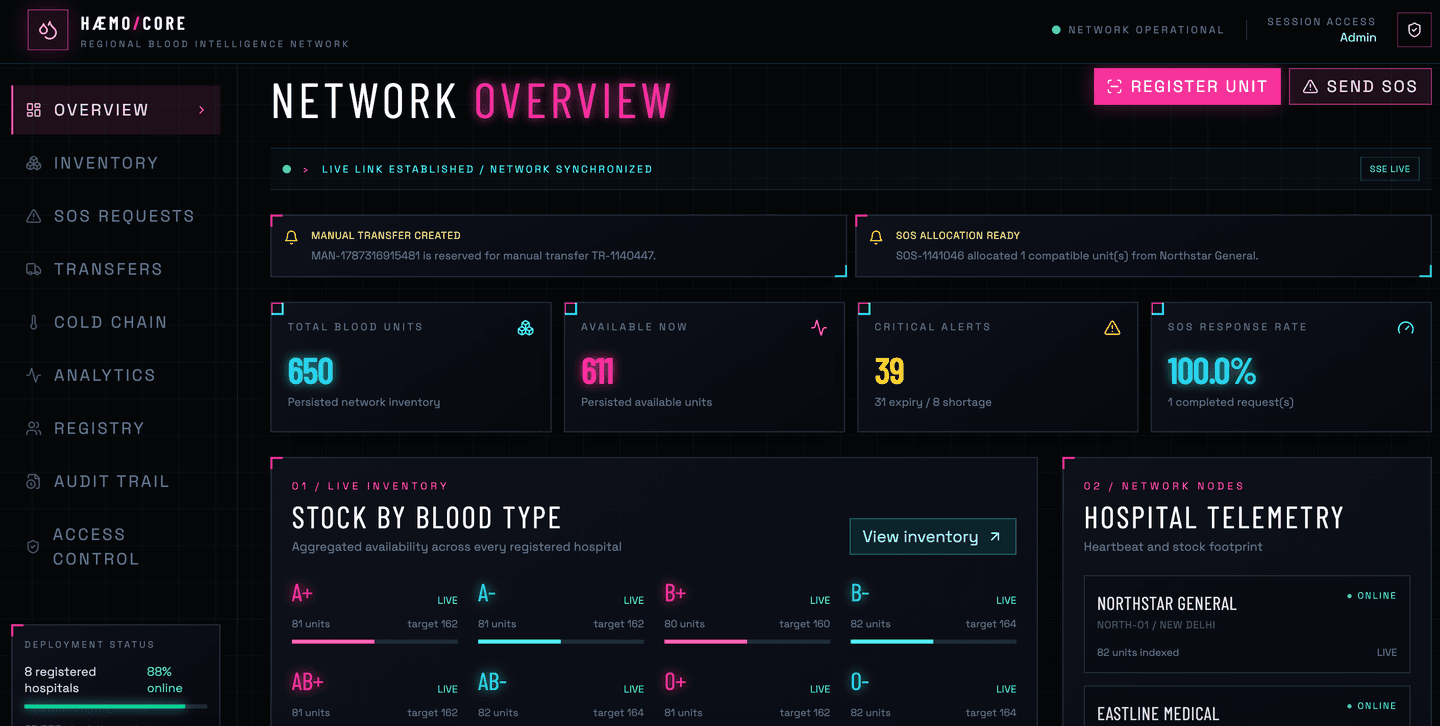
HAEMO/CORE provides a centralized platform that helps hospitals manage and coordinate blood inventory across a connected network.
It can be used to:
- Monitor the availability of different blood groups across multiple hospitals.
- Raise and manage emergency blood requests when required units are not available locally.
- Identify suitable blood units based on compatibility, availability, expiry dates, FIFO prioritization, and hospital proximity.
- Track blood bags throughout their lifecycle using QR/RFID-based identification workflows.
- Manage inter-hospital blood transfers from allocation and dispatch to delivery.
- Reduce wastage by identifying and prioritizing blood units approaching their expiry date.
- Monitor cold-chain conditions and flag potential storage issues.
- Analyze blood usage patterns and support future demand planning.
- Maintain a clear audit trail of important actions and blood movement.
By bringing these processes into a single platform, HAEMO/CORE makes blood management more organized, traceable, and efficient while helping hospitals respond more quickly to time-critical blood requirements.
Challenges I ran into
Challenges I ran into
1. Challenge One: Designing the Smart Blood Allocation System
One of the main challenges was designing an allocation system that could make meaningful decisions instead of simply selecting the first available blood unit. The system needed to consider blood compatibility, availability, expiry dates, FIFO prioritization, and the distance between hospitals.
How I solved it:
I developed a rule-based Smart Allocation Engine that evaluates these factors before selecting and recommending suitable blood units. This allowed the system to prioritize compatible and available units while also considering expiry and proximity.
2. Challenge Two: Managing the Blood Lifecycle
A blood unit can go through multiple stages, including registration, availability, reservation, transfer, delivery, and issuance. Managing these transitions without allowing invalid actions was challenging.
How I solved it:
I implemented structured status transitions and workflow validation. Each stage has defined actions, helping ensure that blood units move through the correct lifecycle. An audit trail was also added to record important changes.
3. Challenge Three: Handling Inter-Hospital Transfers
Coordinating blood transfers between hospitals required clear control over which hospital could perform actions such as approving, dispatching, and confirming delivery.
How I solved it:
I designed a transfer workflow with defined stages and role-based access controls. This helped ensure that actions were performed by the appropriate hospital and that the transfer status could be tracked throughout the process.
4. Challenge Four: Connecting the UI to Real Data
During the early stages of development, some parts of the dashboard relied on simulated or hardcoded data. This made the application look functional without fully representing the actual backend workflow.
How I solved it:
I gradually connected the frontend to the backend and database so that inventory, SOS requests, transfers, and other system information could be retrieved and updated through the actual application workflow.
5. Challenge Five: Implementing QR/RFID Tracking Without Hardware
The project required a way to track individual blood units, but using physical RFID hardware would add additional complexity and dependency on external devices.
How I solved it:
I implemented a software-based QR/RFID identification workflow using unique identifiers for each blood unit. This allowed the complete tracking workflow to be demonstrated without requiring physical hardware, while keeping the system extensible for future integration with actual QR scanners or RFID devices.
6. Challenge Six: Preventing Blood Wastage
Simply tracking blood inventory was not enough. The system also needed to prioritize blood units that were closer to expiry to reduce unnecessary wastage.
How I solved it:
I incorporated FIFO and expiry-based prioritization into the allocation workflow. When suitable blood units are available, the system can prioritize older or earlier-expiring units where appropriate.
Tracks Applied (1)