
ComputeQuest
Turn verified attention into useful AI compute
Created on 30th August 2026
•
ComputeQuest
Turn verified attention into useful AI compute


The problem ComputeQuest solves
AI tools are useful, but subscriptions and usage fees block people who only need occasional compute. At the same time, sponsors pay for impressions without a clear connection to a useful user outcome.
ComputeQuest connects those two needs. A user submits an AI task, such as an eight-slide pitch deck. If the account is short of Compute Energy (CE), the user can voluntarily complete a short Sponsor Quest. The server measures eligible active-view signals, pauses earning when those signals disappear, and authorizes the reward only after the required viewing period. A replay-protected CampaignEscrow contract settles the signed receipt on Monad Testnet. After finalization, ComputeQuest issues non-transferable CE, spends it exactly once, and starts the original Gemini job automatically.
Sponsors fund useful work instead of buying an isolated impression. Users receive a concrete AI result instead of a transferable token. ComputeQuest provides the verification, settlement, ledger, and provider-execution layer. The current public product includes separately funded Monad and PayZoll campaigns, an operator-reviewed sponsor intake path, persisted results, and text, JSON, and PDF exports.
Architecture
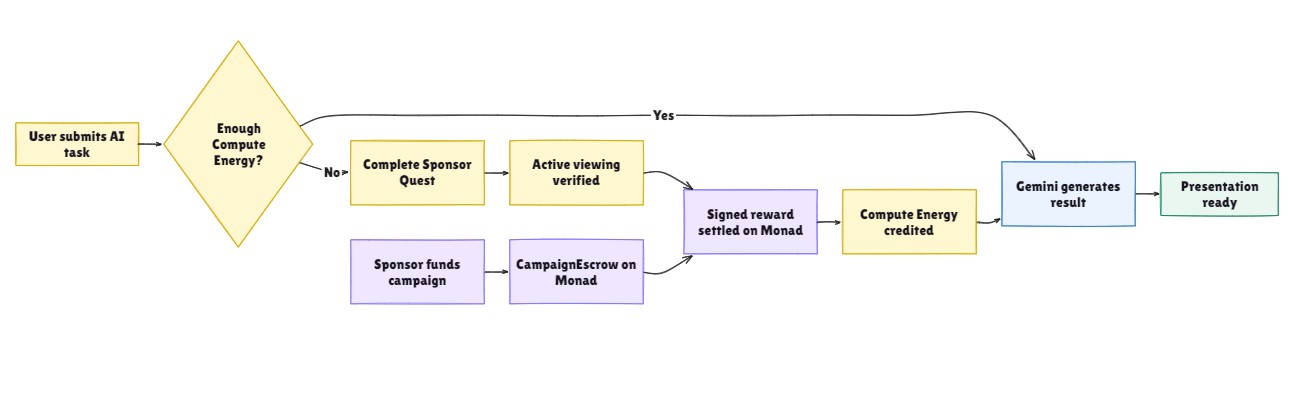
The user-facing task, sponsor-funded CampaignEscrow, verified reward settlement, CE ledger, and Gemini generation remain independently inspectable stages.
Challenges we ran into
The hardest challenge was defining an attention claim a browser can honestly support. A web app cannot lock a laptop or prove where someone is looking. We therefore measure eligible active-view signals instead: visibility, focus, fullscreen, playback, speed, seeking, buffering, Picture-in-Picture state, media-time progression, bounded heartbeat gaps, and server timestamps. Invalid intervals earn zero, and append-only evidence records explain why.
The second challenge was making the money and credit flow exactly-once. PostgreSQL row locks serialize balance decisions, campaign reward claims prevent one account from repeatedly claiming the same campaign, ledger entries are idempotent, and failed provider attempts have attempt-specific refunds. The contract separately protects campaign capacity, budget, signatures, expiry, and session replay.
The third challenge was recovery across network and process failures. Settlement waits for the configured Monad finality boundary, records every relay attempt, and can recover a broadcast transaction from on-chain events. Funded Gemini jobs use a database lease so refreshes or retries do not duplicate provider calls. We also replaced a memory-heavy migration command so the application could boot reliably on Render's constrained runtime.
The result is a public, fail-closed vertical slice backed by 89 application tests, 20 PostgreSQL integration tests, 5 Foundry tests, browser checks, a verified Testnet contract, and publicly inspectable settlement evidence.
Technologies used