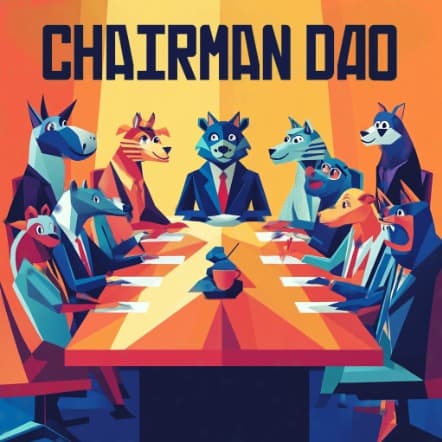
Chairman DAO
DAO Framework for Worker Self-Directed Enterprises
Created on 1st March 2025
•
Chairman DAO
DAO Framework for Worker Self-Directed Enterprises


The problem Chairman DAO solves
DAOs today are primarily designed on top of rigid cryptographic protocols and have limited applicability to real world organizations beyond simple treasuries or reputation systems, with thought to combine the two and to apply it to economist Richard D. Wolff's concept of the Worker Self-Directed Enterprise - a model for a profitable co-op organization where all workers vote on how to spend their surplus profits after wages are paid out.
Our goal with Chairman DAO is to create a more effective, trustless system that creates a framework for inner-organizational arbitration, minimized corruption, and the flexibility of rich controls over reputation and governance; all while driving the adoption of Web3 tools. We aim to make Web3 an invisible implementation detail, providing a seamless and trustworthy service for employee-owners.
User Interaction and Data Flow
Users interact with the service by deploying their own instance, which launches their canisters on an ICP subnet. From there, they can customize a frontend and configure their instance much like a traditional Web2 SaaS application. Each employee gets a simple onboarding experience with a one-click setup for their identity via the Internet Identity protocol. Once signed in, they access a task board—resembling Trello but designed for more structured, high-stakes workflows—where they can submit and claim tasks. Completing tasks earns them health and spirit points, which they can then use on the proposals page to vote on key decisions, ensuring a dynamic and merit-based governance system.
The project architecture and development process
The backend is built on the Internet Computer Protocol (ICP), which we believe is an ideal platform for this type of application. ICP’s canisters function similarly to traditional web services, making them a natural fit for developers familiar with conventional backend architectures. Additionally, ICP excels at serving data, including frontends and larger strings, ensuring efficient and scalable performance. Building a DAO like this on an EVM-based chain would be challenging due to several limitations: high gas costs, limited on-chain storage, and the complexity of managing off-chain data interactions. Smart contracts on EVM chains are primarily designed for financial transactions and lack the efficiency needed for serving frontends or handling large-scale data.
The core of our DAO framework revolves around a dynamic relationship between task completion, earning rewards, and voting power. Employees earn rewards, such as kudos or other incentives, by actively completing tasks. These rewards are then converted into voting power, which can be used to participate in important decisions within the DAO. This creates a meritocratic system where governance is driven by contributions and engagement, rather than passive token ownership. It encourages participation and accountability, ensuring that decisions are made by those who are actively shaping the organization’s success.
Product Integrations
Our solution leverages the full ICP ecosystem, including their powerful tooling stack such as dfx for local development and deployment, the Rust-canister library for writing efficient canister code, and React tools for seamless frontend integration. We also use Candid-Assembler to build the Candid files necessary for inter-canister communication. For authentication, we rely on Internet Identity, which offers a simple, secure way to manage identities within the app. However, it's worth noting that we could theoretically integrate any identity provider that supports ICP, providing flexibility for users who may prefer different authentication solutions.
Key differentiators and uniqueness of the project
A key innovation in our DAO framework is task-based voting power. Unlike traditional DAOs where voting power is tied solely to token holdings, our system requires members to earn their influence. Users gain voting power by completing tasks and receiving recognition—such as kudos—from their peers. This merit-based approach ensures that decision-making is driven by active contributors rather than passive holders, fostering a more engaged, fair, and accountable governance system.
Trade-offs and shortcuts while building
A lot of the front-end functionality is still a work in progress. For now, we’ve managed to implement core features like displaying tasks and proposals, and the ability to add tasks. However, features like claiming tasks, judging claimants, and awarding points were not yet included in the demo. Additionally, the authentication system is a bit of a hack at this stage. We've spent considerable time testing and tweaking the system, and while we know there are still some gaps, we want to emphasize that this is currently a proof of concept.
Despite these limitations, we’re confident that the underlying framework can support trustless and automated tooling for DAOs of all types—not just protocols. Our vision is to build a better, more accessible governance model that will greatly enhance adoption of Web3 tools across a variety of decentralized organizations.
Additional Features
We built everything during the hackathon.
Tracks Applied (2)
Only possible on ICP

Internet Computer
DAOS + COMMUNITIES
Technologies used