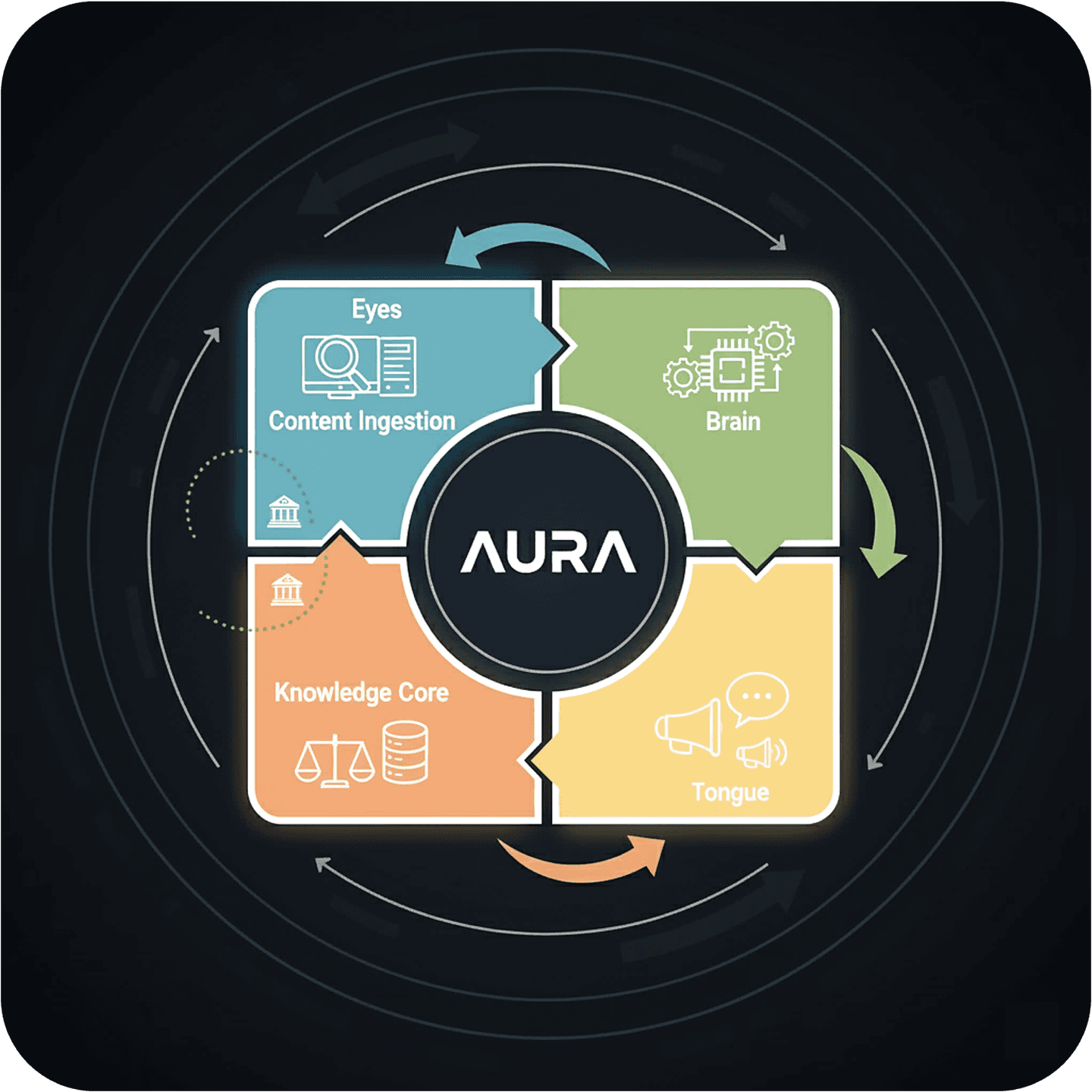
AURA
The Autonomous Unified Response Agent
Created on 16th October 2025
•
AURA
The Autonomous Unified Response Agent


Description of your solution
Project Title: AURA – The Autonomous Unified Response Agent for Crisis Misinformation
Category: Agentic AI for Real-Time Crisis Misinformation Management
Problem Overview
During crises like pandemics, wars, or disasters, social media and online platforms overflow with contradictory, emotionally charged, and often false information. Traditional fact-checking is too slow to match the viral spread of misinformation, creating confusion, panic, and even physical harm.
Our Vision: AURA
AURA (Autonomous Unified Response Agent) is an agentic AI ecosystem designed to autonomously monitor, verify, and counter misinformation in real-time. Built on a multi-agent architecture, AURA coordinates autonomous agents, each with a specialized role, orchestrated by a central “Brain.”
Mission: detect misinformation early, verify it transparently, and educate the public proactively.
📄 The architecture and methodology are detailed in our research paper:
“AURA: An Autonomous Multi-Agent System for Crisis Misinformation Management”
— authored by Sumit Chourasia, Suhani Pandit, Aditya Jha, and Annanya Prasad.
System Overview: How AURA Works
AURA operates as a closed information loop connecting four primary modules:
-
Central Command — The Brain
Role: Orchestrates all agents, detects trends, and directs verification. -
Content Ingestion — The Eyes
Role: Multi-modal agents scan and process text, video, and official data streams. -
Verification Engine — The Knowledge Core
Role: Evidence-based verification via debate mechanisms, RAG, and knowledge graphs. -
Communication Interface — The Tongue
Role: Creates audience-specific explanations and prebunking content.
The “Eyes”: Multi-Modal Scanning Agents
These agents form AURA’s sensory layer, continuously ingesting information:
- Social Media Stream Monitor: Scans X, Facebook, TikTok then filters crisis content via NLP and geotags.
- News & Blog Scanner: Extracts articles; performs sentiment and framing analysis.
- Video & Audio Transcriber: Uses STT, OCR, and Vision AI to extract text and visuals from multimedia.
- Government Source Monitor: Tracks press releases, advisories, and WHO/UN data as the “ground truth.”
Output: Structured data packets (text, metadata, timestamps, entities) → streamed via Kafka to the Brain.
The “Brain”: Central Orchestrator
Receives signals from the Eyes for trend detection, clustering, and orchestration:
- Trend Detection Engine: Groups similar claims; detects viral falsehoods early.
- Crisis Context Module: Uses domain knowledge (pandemics, elections, disasters) to interpret data.
- Task Orchestrator: Assigns high-priority claims to the Knowledge Core, directs further evidence collection, and instructs Tongue on communication.
- Data Flow: Eyes → Brain (clustering + prioritization) → Knowledge Core (verification) → Tongue (communication)
The “Knowledge Core”: Verification and Evidence Engine
AURA’s truth machine:
- Dynamic Knowledge Graph (Neo4j): Continuously updated with verified facts.
- Multi-Agent Debate Framework: Agents (supporting, opposing, skeptic, judge) debate claims using RAG.
- Source Credibility Agent: Scores sources based on accuracy, bias, and transparency.
Process: Claim → Knowledge Graph lookup → Debate → Credibility scoring → Verdict + Evidence
Output: Verified claim (True/False/Misleading) + Confidence score + Evidence trace
The “Tongue”: Contextual Explanation & Public Interface
Converts verification results into human-readable insights:
- RAG-based Explanation Generator: Produces grounded, evidence-linked summaries.
- Audience-Specific LLMs: Tailored tone for citizens (simple), journalists (concise + citations), government (technical).
- Gamified Prebunking Module: 90-second “misinformation defense” mini-game that reduced misinformation sharing intent by 28% (Cambridge University, 2022) — [Van der Linden et al., Nature Human Behaviour, 2022].
Outputs: Crisis dashboards, media fact-check reports, API alerts for government systems
Information Flow Summary:
- Ingestion: Eyes collect multi-modal data.
- Analysis: Brain clusters and prioritizes misinformation.
- Verification: Knowledge Core fact-checks via debate, graph search, and credibility scoring.
- Explanation: Tongue generates narratives and prebunking experiences.
Feedback Loop:
- User submissions and corrections retrain Brain.
- Knowledge Core updates graphs with new verified data.
Research Reference:
Chourasia, S., Pandit, S., Jha, A., & Prasad, A. “AURA: The Autonomous Unified Response Agent for Crisis Misinformation” . Read Full Paper -
Tracks Applied (1)
Misinformation: Create an Agentic AI system that continuously scans multiple sources of information, detects emerging misinformation, verifies facts, and provides easy-to-understand, contextual updates to the public during crises.
Technologies used
Solidity
HTML
React
Node.js
CSS
JavaScript
Flask
Python
elasticsearch
MongoDB
YOLOv3 Algorithm
Tailwind CSS
Neo4j
FastAPI
langchain
Pinecone
crewai
LangGraph
VAPI
OpenAI / Llama 3 LLMs
Hugging Face Transformers + spaCy (NLP & Entity Extraction)
React + Next.js Frontend (Public, Journalist & Govt Interfaces)
HuggingFaceTransformer
HuggingFaceSpacy
OpenaiLLM