>_ALPHABIT
Find Alpha in The Bit.
Created on 12th January 2026
•
>_ALPHABIT
Find Alpha in The Bit.


The problem >_ALPHABIT solves
Imagine walking into a casino for the first time—but instead of slot machines and card tables, you're faced with spreadsheets full of Greek letters, flashing numbers, and terminology that sounds like it belongs in a physics lecture.
That's what DeFi options trading feels like for most people today.
Even on innovative platforms like Thetanuts Finance, which are pushing the boundaries of on-chain options, the experience often leaves everyday users feeling overwhelmed and excluded. Terms like Delta, Gamma, Implied Volatility, and Strike Price create an invisible wall that keeps DeFi options as a playground for sophisticated traders only.
But the problem runs deeper than complexity:
- 💸 The "Quick Yield" Trap: Most users jump into DeFi, grab some quick returns, and leave. There's no reason to stay, no emotional connection to keep them coming back.
- 🤫 The Lonely Trader Problem: Trading feels like shouting into the void. You can't easily share wins, prove your skills, or build a reputation—making the experience feel hollow.
🚀 How ALPHABIT Changes the Game
We asked ourselves: What if DeFi options felt less like Wall Street and more like an arcade?
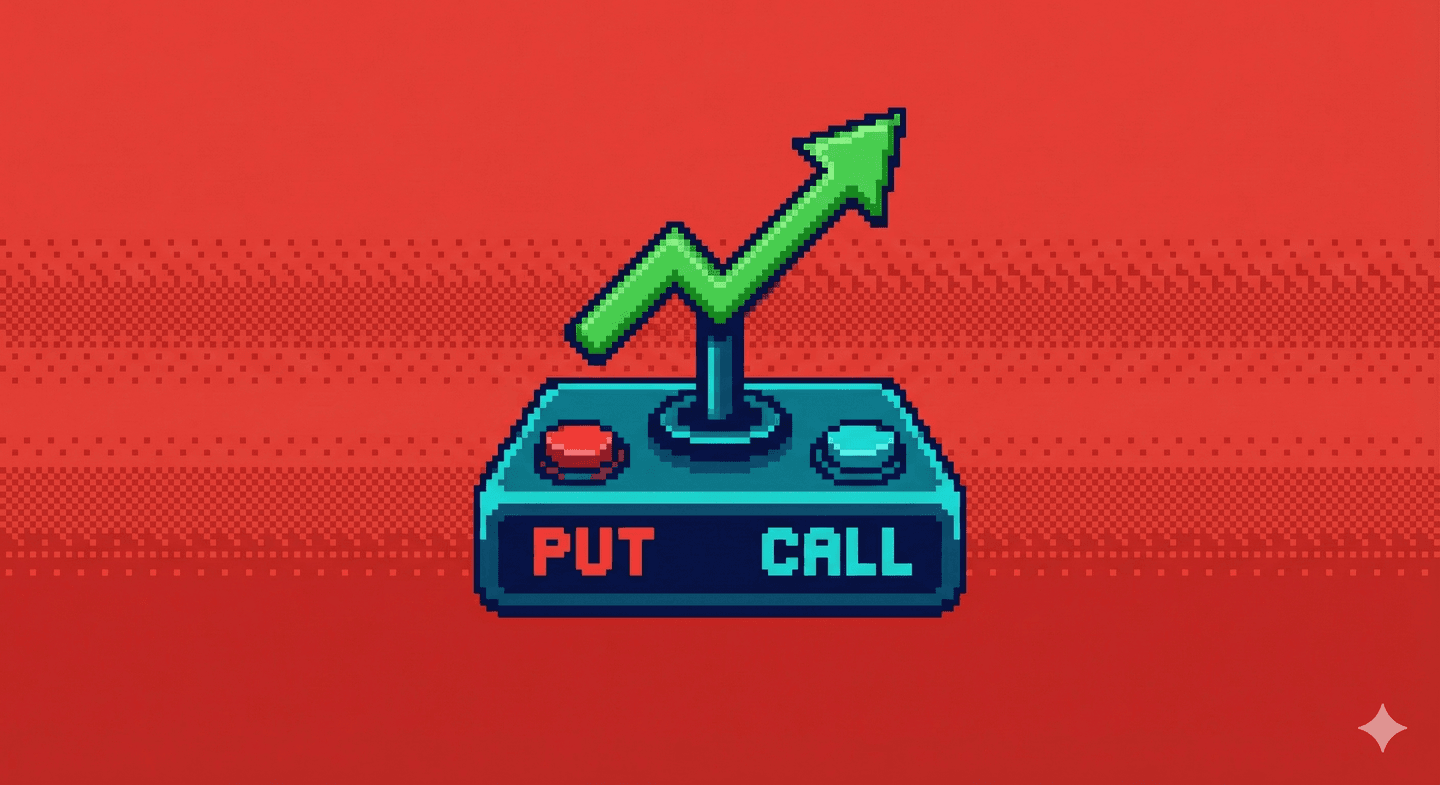
ALPHABIT transforms the complexity of options trading into an addictive 8-bit gaming experience—right inside Farcaster Frames where communities already live.
1. 👾 Making the Complex Feel Simple
We didn't just hide the math—we translated it into a language everyone understands: games.
- HUNT Mode = Buying options becomes predicting: Will the price go Higher or Lower? That's it. No order books, no confusing interfaces.
- FARM Mode = Earning yield becomes building "Yield Reactors" and "Shields"—visual metaphors that make vault strategies intuitive.
The Result? First-time users can start trading options in seconds, not hours. The learning curve becomes a fun ramp, not a wall.
2. 🔥 Making DeFi Sticky
We borrowed from the best game designers to solve DeFi's biggest problem: people leave.
- Streak Counters: Win three in a row? Your avatar catches 🔥. Miss a day? Break your streak. This simple psychological hook keeps users coming back.
- Daily Challenges: Small missions create reasons to return beyond just "making money."
The Result? Users don't just trade—they play. And players come back.
3. 🏆 Making Trading Social
Trading alone is boring. Trading with friends is addictive.
- One-Click Sharing: Share your winning streak to Warpcast with a single tap—complete with dynamic, verifiable proof images.
- Weekly Leaderboards: Compete in "Weekly Survivor" rankings. Turn every trade into a sport.
- Verifiable Flexing: No more fake screenshots. Every achievement is on-chain and provably real.
The Result? ALPHABIT turns solitary speculation into a community sport—creating organic growth as users recruit their friends.
Our Vision: We believe DeFi should feel like a game everyone can win—not a test only experts can pass. ALPHABIT is our answer: making options trading on Base accessible, engaging, and genuinely fun—while driving real volume to protocols like Thetanuts.
The future of DeFi is playable. Welcome to the arcade. 🕹️
Challenges we ran into
Building ALPHABIT was a journey of balancing simple 8-bit game mechanics with complex DeFi protocols. Here are the specific hurdles we faced and how we engineered our way around them.
1. ⚡ The "Blitz Mode" Dilemma: Protocol Constraints vs. Game Mechanics
One of our core game features is "Blitz Mode" (2–9 hour expiry) to keep the gameplay fast-paced and addictive. However, we hit a wall with Thetanuts' standard vaults, which typically operate on weekly epochs.
The Hurdle:
We attempted to use the Request for Quote (RFQ) system to create custom short-duration options. However, the RFQ flow creates friction (waiting for market maker acceptance), which kills the instant gratification needed for a game.
The Fix:
We built a Duration Bucketing System that maps our game timeframes to the nearest available on-chain expirations:
| Game Mode | Timeframe |
|---|---|
| 🔥 BLITZ | 2H – 9H |
| 💨 RUSH | 9H – 18H |
| ❄️ CORE | 18H – 36H |
| 🌍 ORBIT | >36H |
This gives players the feel of short-term trades while working within protocol constraints. We're also actively engaging with Thetanuts governance for shorter epoch support.
2. 🧠 Bridging the Knowledge Gap: From "Greeks" to "Pixels"
Our team has strong frontend skills, but translating complex Options mechanics (Delta, Gamma, Strike Prices) into simple 8-bit logic was daunting. We struggled to abstract the math without losing financial accuracy.
The Fix:
We built a comprehensive Abstraction Layer that transforms intimidating financial jargon into game-friendly concepts:
| Financial Metric | Game Stat | Explanation |
|---|---|---|
| Delta | Power Level | ITM probability as "signal strength" |
| Theta | Decay Timer | Time decay shown as countdown |
| Gamma | Volatility | "Critical hit" / spike likelihood |
| Strike | Target | Price level to hit |
| Premium | Entry Cost | Cost to join the round |
This led to our "Tactical Droid" (R.O.B.B.I.E. 9000) – an AI copilot that translates complex market analysis into arcade-style recommendations like "Signal Detected: MOON target on ETH, Blitz duration."
We turned this hackathon into a crash course. We attended every Base x Thetanuts AMA and questioned the developers about smart contract nuances. We realized we weren't just building a UI; we were building a "translator" layer.
3. 🌑 Developing in the Dark (Mainnet Constraints)
Thetanuts does not have a comprehensive testnet environment for the specific v3 contracts we needed. Testing with real assets (NUTS/USDC) on Mainnet was risky and costly during the debugging phase.
The Fix:
We utilized Tenderly Mainnet Forks. This allowed us to:
- Fork the Base Mainnet state at any block
- Simulate transactions against live Thetanuts contracts with unlimited "fake" tokens
- Debug our smart contract interactions in a sandbox environment
This saved us significant gas costs and prevented costly mistakes before deploying real funds.
4. 🔍 Filtering the Noise: Logic Mapping for Order Fetching
While integrating the Thetanuts Basic Vaults via API, we faced a complex data logic challenge.
The Hurdle:
The game input is binary ("UP" or "DOWN"), but the order book returns a complex array of strikes and premiums. Mapping a simple "HUNT" action to the best possible option order programmatically was difficult.
The Fix:
We built a custom "Best Execution Matcher" in our backend. When a user clicks "UP", our system:
- Scans the fetched orders
- Scores each option by premium cost (65% weight) and strike proximity to spot price (35% weight)
- Prefers options that are slightly out-of-the-money (better risk/reward)
- Selects the optimal order automatically
This ensures fair market positioning without overwhelming the user with choice paralysis.
5. 👛 Wallet Context Ambiguity on Farcaster Frames
Integrating Neynar for Farcaster identity verification introduced a subtle but critical issue regarding wallet detection.
The Hurdle:
When verifying users via Neynar, it was ambiguous whether the returned address belonged to the Base App embedded wallet or an external connected wallet (like MetaMask). This lack of context made it difficult to tailor the signing UX and error handling, as different wallets behave differently within a Frame.
The Fix:
We adopted an environment-agnostic architecture. Instead of building fragile conditional logic based on wallet type, we designed transaction flows to be resilient universally. Crucially, we stopped relying on client-side callbacks for success states and shifted to listening for on-chain events to confirm transactions. This ensures the game state updates correctly regardless of the wallet provider used.
6. 📊 Real-Time Price Data: The Oracle Fallback Dance
Displaying accurate, real-time prices is critical for both t
Tracks Applied (1)
Thetanuts Finance Track
Technologies used